Cross-Lingual Hallucination Drift in LLMs
Does an LLM hallucinate more in some languages, and does it depend on the task?
Output
Problem
Do LLMs hallucinate more in lower-resource languages, and does that drift depend on the task? A tempting early result (huge drift on Swahili commonsense reasoning but none on Spanish factual QA) conflates two things: is it the task, or just the specific language? Measuring this rigorously means controlling for that confound.
Approach
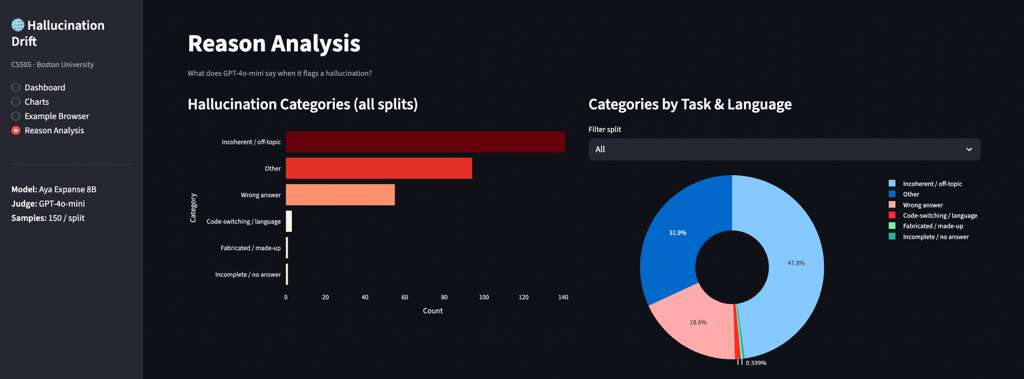
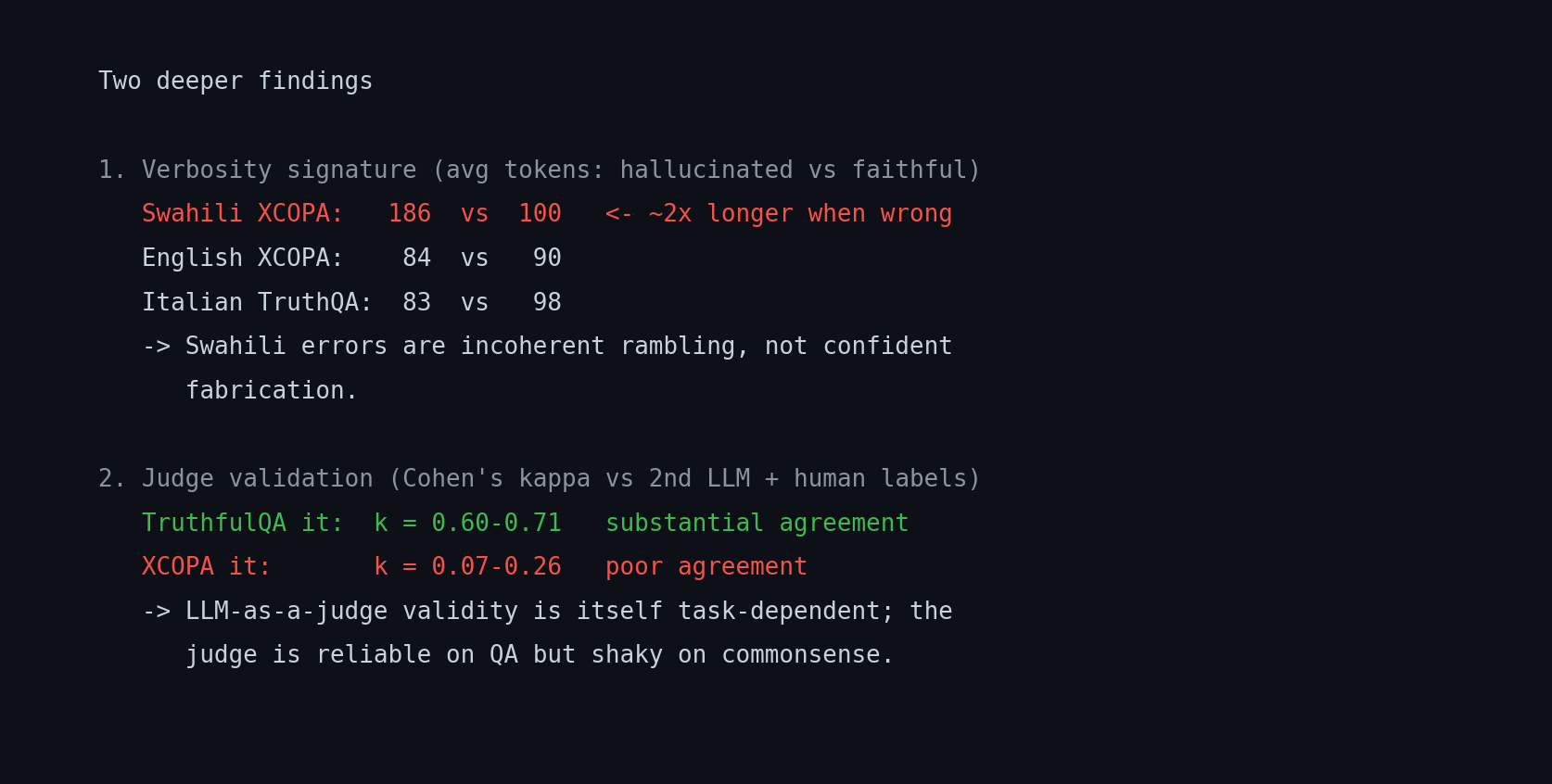
Evaluated Aya Expanse 8B (multilingual, zero-shot) on two tasks, TruthfulQA (factual QA) and XCOPA (commonsense reasoning), across English, Spanish, Italian, and Swahili, with GPT-4o-mini as an automated hallucination judge (150 samples per cell, 6 cells). Italian was added specifically because it is the one language present in *both* datasets, breaking the task-vs-language confound. Findings were stress-tested with Mann-Whitney U, chi-squared, and Fisher exact tests, and the judge itself was validated against a second LLM judge and human labels via Cohen's κ.
Result
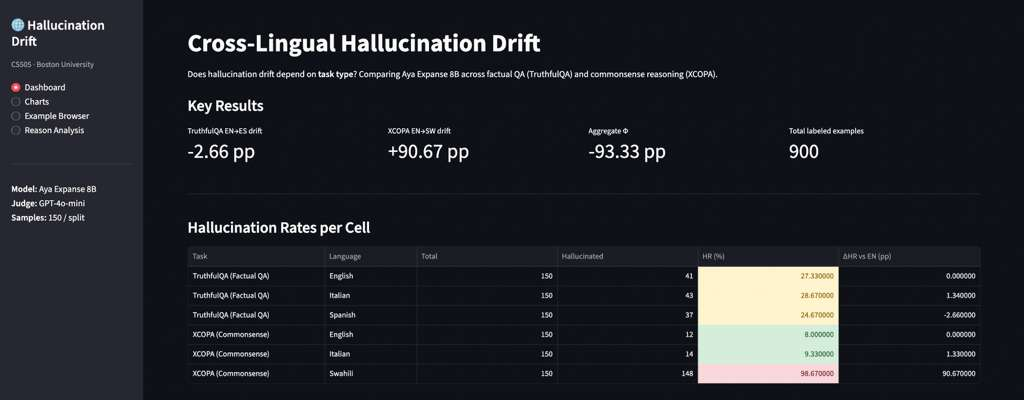
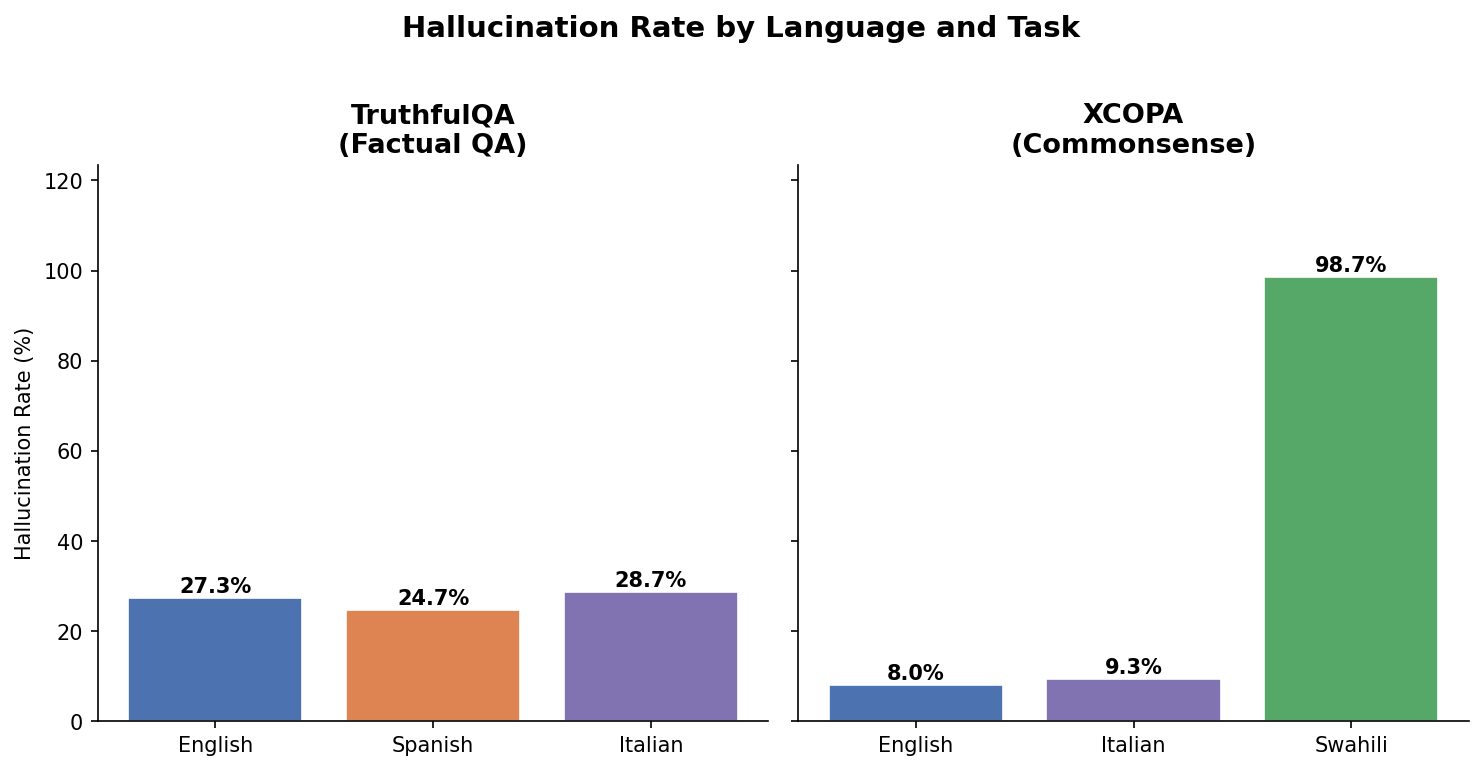
The model did not hallucinate more in "harder" languages across the board. The rate barely moved except in one cell: Swahili commonsense reasoning, where it jumped to 99% (vs 8% in English). Adding Italian as a shared control showed this was a single-cell effect, not a general low-resource pattern.
| Task | English | Spanish | Italian | Swahili |
|---|---|---|---|---|
| TruthfulQA (factual QA) | 27.3 | 24.7 | 28.7 | — |
| XCOPA (commonsense) | 8.0 | — | 9.3 | 98.7 |
Hallucination rate (%), Aya Expanse 8B, 150 samples per cell
Highlights
- Confound-controlled design: Italian added as the one language shared by both datasets
- 6 evaluation cells × 150 samples, GPT-4o-mini judge with auto-retry
- Statistical rigor: Mann-Whitney U, chi-squared, Fisher exact, drift-interaction Φ
- Judge validation via dual-LLM + human labels (Cohen's κ); found judge validity is task-dependent